
Prepare
Financial Preparedness: Build Your House on Rock
Debt feels like freedom until the day it isn't. Here's how to build a financial foundation that can hold up when hard times come.
What a sign painter learned about money
I grew up a sign painter because of my father. He was a wonderful man. Everybody loved him, and people still talk about him, even though he's been gone 22 years. He had a great sense of humor and he loved people, and that's how he built a sign business that at one point had 65 employees.
But he made a money mistake of his own. He grew by doing too many things, making too many different kinds of signs, until the business became unmanageable. I got into digital printing partly to help him, and in the end, he came to work for me.
In 1992, I took a big risk. I borrowed a lot of money to buy equipment and became one of the first digital printers in the country. I felt inspired to do it, and it was some of the hardest work of my life. But it paid off. The business grew fast, and over the years we did work for companies like Apple, IBM, General Motors and Macy's, for the National Gallery of Art, and for two Super Bowls and two Olympics.
Here's the mistake I didn't see coming. Somewhere along the way, my business changed. I had built a foothold in a new market, and what I really had become was a sales company. My salespeople, my prepress team and my accountant were the heart of it. But I still thought like a printer, so when it was time to grow, I bought more equipment. Bigger, more expensive machines, on more debt. When that equipment didn't perform, it took the business down with it.
There's a second lesson in that too. Looking back, there were times I felt prompted to change direction, and I didn't listen. I've lived with the cost of that ever since.
So I'm not writing this as a financial expert. Money hasn't always been my strong suit, and I've leaned on people who know this better than I do. But I've learned some lessons the hard way, and I'd love to save you from learning them the same way.

Why this matters now
According to the Federal Reserve, more than a third of American adults couldn't cover a surprise $400 expense with cash or its equivalent. That's a car repair. A trip to the emergency room. A broken furnace in January.
Now imagine a real emergency: a job loss, an injury, an evacuation, or a long stretch when prices keep climbing. Every disaster guide on this site comes back to the same truth. The families with a cushion get through it. The families living paycheck to paycheck, with every dollar already spoken for, get hit twice.
Why everything costs more. Prices didn't jump overnight, and there's no single villain. Economists point to a mix of causes: trillions of dollars in pandemic spending that pushed demand up, supply chains that broke down, an energy shock when Russia invaded Ukraine, and a tight job market that pushed wages and prices higher together. Whatever you think caused it, the answer for your family is the same: spend less than you earn, get out of debt, and keep a reserve.
I believe harder times are coming. That's not meant to scare you. It's the reason to start building your foundation now, while you still can.
The world's way and the wise way
The world has a way of making money look easy. Buy more house than you need, because the bank says you qualify. Buy the new truck, because the payment fits. Borrow to buy rental homes and businesses, and as long as the money coming in covers the payments, you're "rich."
I followed some of the success gurus for a while. All they did was take my money. And here's something worth knowing: one of the most famous cash-flow gurus in the country said on a podcast recently that he's about $1.2 billion in debt. Then he told listeners, "People should not do what I do."
Years ago I knew a woman who did everything the gurus told her. She bought six homes, rented them all out, and everything cash flowed beautifully. Then the market dropped. She lost one house, then another, and another, until she lost the home she was living in and had to rent it back. "I did everything they told me to do!" she said. She was right. That was the problem.
The world's way is a house of cards. It looks impressive, right up until it falls.
Building on rock
My church has taught the same simple principles about money for as long as I can remember, and you don't have to share my faith to use them. They work for anybody:
- Spend less than you earn. Every month. It's the foundation everything else stands on.
- Use a budget. Know where your money is going before it goes.
- Live modestly. Buy a modest home and a modest car. Just because the bank says you can afford the $500,000 house doesn't mean you should buy it. Buy the $200,000 house, pay it off early, and you own it. The bank doesn't. Every financial decision after that gets made without the pressure of debt.
- Get out of debt, and stay out. Any way you possibly can.
- Build a reserve. Money set aside, plus food and supplies on the shelf.
- Never stop learning. Get all the education you can, but don't bury yourself in debt to get it.
- Seek counsel from people who don't profit from your choices. If someone makes money when you borrow, buy, or sign up, weigh their advice carefully.
The real goal isn't to look rich. It's stewardship: owning what you have, taking care of it, and being in a position to help others when they need it.

Where to start
You don't have to fix everything this month. Work through these one at a time.
1. Start a small cushion
Before anything else, set aside a starter emergency fund, even if it's just a few hundred dollars. It keeps a flat tire or a doctor's bill from going on a credit card. Put it in a separate savings account so you're not tempted to spend it.
2. Make a simple budget
Write down what comes in each month and where it goes. Most people find money leaking out in places they didn't expect. The Consumer Financial Protection Bureau has free worksheets that make this easy.
3. Go after your debt
List every debt you owe, from credit cards and car loans to medical bills, with the balance and the interest rate. Then pick a method and stick with it:
- Smallest balance first. Pay the minimum on everything, and throw every extra dollar at the smallest debt. When it's gone, roll that payment into the next one. The quick wins keep you going.
- Highest interest first. Same idea, but you start with the highest interest rate. It saves the most money over time.
Either way works. The one you'll actually stick with is the right one. And while you're paying debt off, stop adding new debt.
4. Build a real reserve
Once the high-interest debt is gone, grow your emergency fund toward three to six months of basic expenses. That's what carries a family through a job loss without losing the house.
5. Keep some cash at home
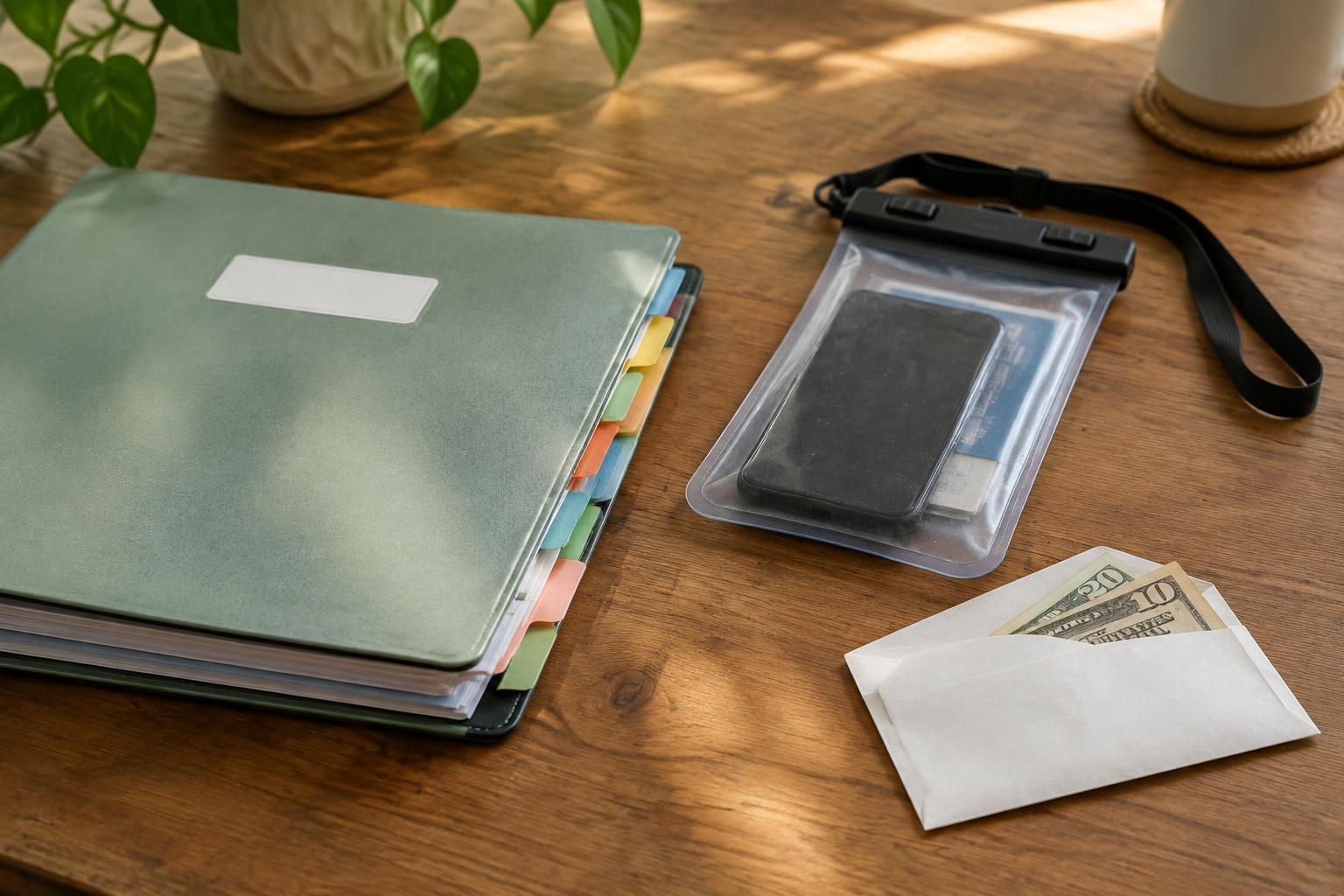
When the power is out, card readers and ATMs don't work. Keep enough cash at home, in small bills, to buy gas, groceries and supplies for a week or two.
6. Check your insurance
Pull out your policies and read what they actually cover. Regular homeowner's insurance doesn't cover floods, and many policies have limits on things like wildfire smoke damage or earthquakes. Make sure you have enough coverage to rebuild, and keep a copy of every policy in your grab-and-go binder.
7. Put your papers in one place
FEMA has a free Emergency Financial First Aid Kit that walks you through gathering the documents you'd need after a disaster: IDs, insurance policies, deeds and titles, bank and credit card information, medical records and important phone numbers. Keep the originals somewhere safe, copies in a waterproof bag you can grab, and a digital copy somewhere off-site.
8. Pay off your home
If you own a home, even a little extra toward the principal each month can take years off the loan. There's no feeling quite like owning the roof over your head.
9. Watch out for scams
After every disaster, the scammers show up: fake contractors who take a deposit and disappear, fake charities, and people pretending to be from FEMA or your insurance company. Never pay a contractor in full up front, and never give your bank or Social Security information to someone who calls you.
Food storage is financial preparedness too
When prices climb, a stocked pantry is money in the bank. Food you bought last year at last year's prices feeds your family this year. If you lose a job, your food storage stretches your savings for months. That's why food storage and financial preparedness go hand in hand. My Food Storage page and Food Storage Calculator can help you get started.
It's never too late
Wherever you are today, whether you're buried in debt, starting over, or just never learned this stuff, the next step is the same. Spend a little less than you make. Pay off one thing. Set aside a little. Do it again next month.
You may not feel like you're getting anywhere at first. But a foundation is built one stone at a time, and every stone you lay makes the next storm a little easier to stand through.
Trusted sources
Everything on this page follows guidance from the sources below. They're free, and they don't profit from your choices:
- Consumer Financial Protection Bureau: Saving for Emergencies
- Consumer Financial Protection Bureau: How to Reduce Your Debt
- FEMA: Emergency Financial First Aid Kit
- FDIC: Money Smart for Adults
- Federal Reserve: Economic Well-Being of U.S. Households
- For Latter-day Saint readers: the Church's free Personal Finances for Self-Reliance course, taught in local groups around the world.
Keep going
- New to all this? Start with my Start Here page.
- Want to know more about me and why I built this site? Visit my About page.
- My Spiritual Preparation page talks more about stewardship and why I prepare.
- Use the Family Emergency Planner to put your own plan on paper.